
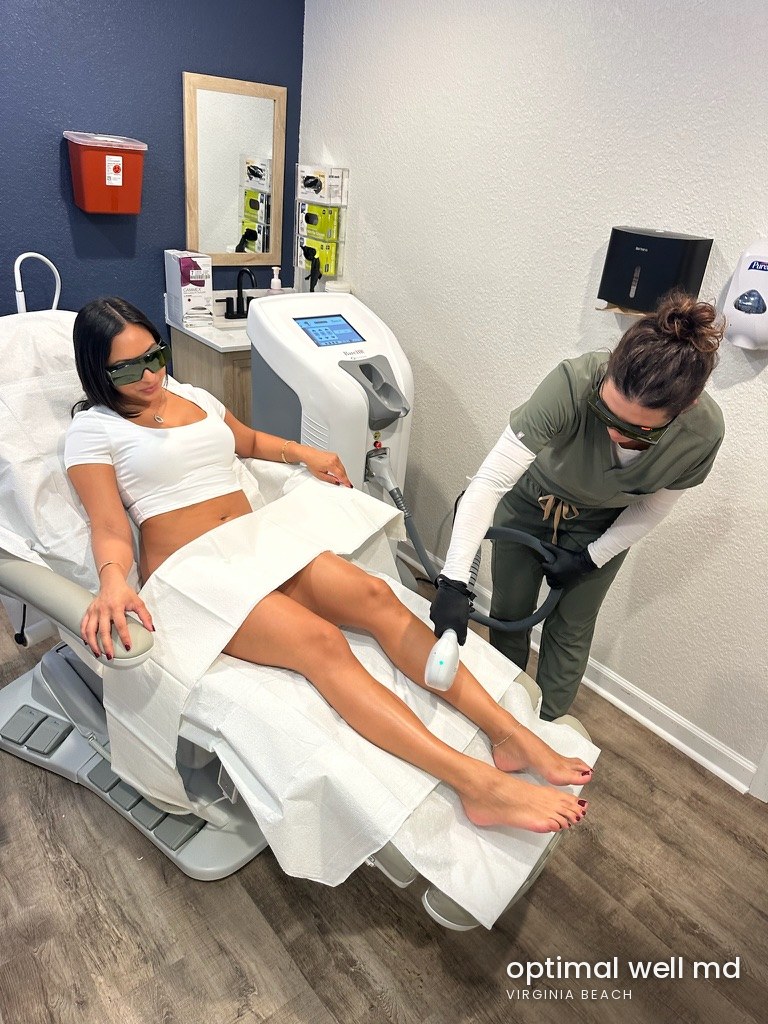
If you’re wondering how many laser hair removal sessions you really need, most people require a series of treatments rather than a single visit, often in the range of six to eight sessions spaced several weeks apart. At Optimal Well MD in Virginia Beach, Dr. Nancy Ferrel and team tailor a plan to your hair, skin, and treatment area. This guide explains why multiple sessions are needed and what influences your personal number.
Ready to book your Laser Hair Removal appointment in Virginia Beach? Your session count depends on hair type, area and skin tone.
Book Your Laser Hair Removal Appointment See Laser Hair Removal details & pricing
Why Laser Hair Removal Takes Multiple Sessions
Laser hair removal works by targeting the pigment in hair follicles during their active growth phase. The catch is that your hairs are not all growing at the same time. At any given moment, only a portion of follicles in a treatment area are in the active phase where the laser is most effective.
Because of this natural cycle, a single session can only treat the hairs that happen to be active that day. Repeat sessions, spaced to match the growth cycle, allow the laser to catch more follicles over time. That’s why a course of treatments spread across several weeks tends to produce the most noticeable, lasting reduction.
This is also why it can look like hair is still present between early sessions. Some of what you see is regrowth from follicles that weren’t in the active phase during your last visit, and some is hair being shed. Staying on schedule gives the laser repeated opportunities to reach each follicle at the right moment, which is the key to steady progress.

How Many Sessions Will You Need?
Many people see meaningful results after roughly six to eight sessions, though some need fewer and others need more. Treatments are typically spaced about four to six weeks apart, depending on the area, so a full course often spans several months. Your provider will recommend a schedule based on how your hair responds along the way.
It’s worth setting realistic expectations. Laser hair removal is more accurately described as long-term hair reduction rather than permanent removal of every hair. Results vary from person to person, and occasional maintenance may be part of keeping the area smooth.
Facial and hormonally influenced areas sometimes need more sessions than areas like the lower legs or underarms. Rather than focusing on a fixed number, it helps to think of your plan as a series that your provider adjusts based on how your hair responds. Checking in on progress along the way lets you fine-tune both the spacing and the total number of visits.
What Affects Your Number of Sessions
Several factors shape how many treatments you’ll need and how you’ll respond. Your provider will consider these when building your plan:
- Hair color and thickness: Darker, coarser hair often responds more readily than fine or light hair.
- Skin tone: Modern devices can treat a range of skin tones, and your provider will select appropriate settings for safety and effectiveness.
- Treatment area: Larger or hormonally influenced areas may require more sessions than small, simple ones.
- Hormones and health factors: Certain conditions and medications can affect hair growth and results.
- Consistency: Keeping to your recommended schedule helps the laser match your hair’s growth cycle.
What to Expect During and After Treatment
A little preparation helps each session go smoothly. Providers generally ask you to shave the area beforehand rather than wax or pluck, since the laser targets the follicle and needs the root intact below the surface. Avoiding sun exposure and self-tanner before and after treatment is also commonly advised. Your provider will give you specific instructions based on your skin and the area being treated.
During a session, you’ll wear protective eyewear while the device passes over the area. Many people describe the sensation as a quick snap or warmth. Sessions can be brief for small areas and longer for larger ones. Afterward, the treated skin may look slightly pink or feel similar to a mild sunburn for a short time.
Temporary redness or swelling around the follicles is common and usually settles quickly. In the days after a session, you may notice what looks like tiny stubble working its way out as treated hairs shed, which is a normal part of the process rather than regrowth. Your provider will share aftercare guidance, which often includes sun protection and avoiding heat, hot tubs, or harsh products on the area for a short period.
Maintenance and Long-Term Results
Once you complete your initial series, many people enjoy a significant reduction in hair. Some choose occasional maintenance sessions to address any regrowth, since hormones and other factors can reactivate follicles over time. These touch-ups are usually spaced much further apart than your initial series, sometimes once or twice a year, and many people find the upkeep minimal compared with a lifetime of shaving or waxing. Because results vary, your provider can help you decide whether and when maintenance makes sense for you and the specific area you’re treating.
Booking Laser Hair Removal in Virginia Beach
The most reliable way to learn your ideal number of sessions is a personalized consultation. To learn more about laser hair removal or to build a treatment plan for your goals, contact Optimal Well MD and our team will be glad to help.
Ready to take the next step? Book your laser hair removal appointment online and pick a time that works for you.
Book Laser Hair Removal at Optimal Well MD
Physician-led care with Dr. Nancy Ferrel and team in Virginia Beach. Same-week appointments are often available.
This article is for general educational purposes and is not medical advice. Treatments referenced require evaluation by a qualified provider. Individual results vary. Please consult Optimal Well MD or your physician about your specific situation.